Showing posts with label Medicinal Trees. Show all posts

Saturday, June 4, 2011

Figs – Medicine store in a tree


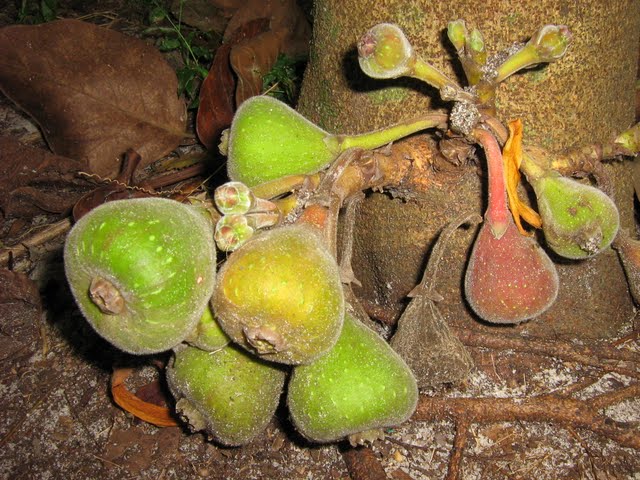
The photos given below were taken during my last trip to Olavipe. We call the tree athimaram and the fruit athipazham. I am told that in English it is known as Elephant Ear Fig tree or Giant Indian Fig and the botanical name is Ficus auriculata Lour. It grows wild, to about 10m or so height.


Click to enlarge
Copyright reserved.
 
Fig is an ancient fruit tree. Its cultivation is believed to have started two or three millenniums back. There are nearly 800 types of Ficus genus. This in the photo is one. They belong to the mulberry family. Fig is Brahma’s Holy Tree and is also mentioned in the Bible and the Koran. The banyan tree also belongs to this group and therefore is significant to the Buddhists as well. Adam and Eve, it is said, covered their nakedness with fig leaves when they were banished from Eden.

I think the most important fig is Ficus carica Linn [Moraceae]. Its nutritive index is 11 against 9 of apple. It is supposed to contain vitamins and minerals including vitamin A, vitamin B1, vitamin B2, iron, calcium, manganese, phosphorus, sodium, potassium chlorine, Omega 3, Omega 6, calcium, Pectin and so on.

Some of the problems where Ficus carica is said to be helpful include, sexual weakness, smooth labour, lowering cholesterol, preventing coronary heart disease, protect against cancer, effectively control of diabetes, management of hypertension, resisting vision loss in elderly people, and strengthening of bones.  

The fruits are seasonal. But dried fruits are available in shops throughout the year. In fact, 80% of the production is consumed in dry form. In certain cases figs are used as replacement for sugar. They also have an important presence in the confectionery industry.

Fig is truly a wonderful fruit.


Monday, February 14, 2011

A Medicinal Tree With Many Names And Great Uses

Tropical America was probably the original home of this tree. From there it spread to Philippines, South East Asia, India, Pakistan and Sri Lanka and to some other areas too.  It has so much of medicinal value and adds flavour to local cuisine.

In the small Indian State of Kerala where the little cucumber shaped fruit of this tree is often used in cooking it is known by several names - Ilimbi, Ilumbanpuli, Bilimbi, Chilimbi, Irumban puli, Chemmeen puli, Keerichakka. In my area it is called ‘chemmipuli’ possibly because it goes well in curried shrimps.

The botanical name of this tree is Averrhoa Bilimbi Linn. In English it is called bilimbi or cucumber tree. It grows to a height of 5m to 12m.

Some of the photographs of the tree I took at Kerala are given below. 


Copyright Reserved.

You will note that the fruits grow on the trunk and branches that are old. The Vitamin C rich fruits are used mainly for curries and flavouring. Bilimbi chutney with coconut is excellent. Different types of pickles are made with this fruit. One of them is made after sun drying the fruit. The larger fruits are cut into small pieces for pickling. Even the pickles can be used for flavouring.

Till recently bilimbi did not have much commercial potential. But of late pickles and other products made from it are being exported to Western countries. Now even jams, squashes, toffees etc are also produced from this fruit. For some recipes see http://groups.yahoo.com/group/gulf-goans/message/3629

It is claimed that bilimbi has extensive medicinal properties which are used in different countries. The leaves are considered good for handling diabetes and cholesterol. A paste made from them is used in treating itches, mumps, rheumatism, and pimples. Direct consumption of the leaves, or concoctions made from them are said to be effective for managing syphilis and inflammation of the rectum.

Coughs and cold are treated with an infusion of the flowers. The fruit is an astringent and is good for removing stains on clothes. It stimulates gastric digestion and sharpens appetite. A syrup made from the fruit juice is taken as a tonic.  It also brings down body heat and temperature and is considered effective against scurvy. The fruit can be used in treating piles, beriberi and liver/bile problems.

Ayurveda acknowledges that bilimbi is effective in anaemia, anorexia, vata, pitta, scurvy, haemorrhoids, internal haemorrhage, hypercholestremia, hepato-splenomegali, fever, poison, gingivitis, vomiting, ringworm and indigestion.

I now think of the bilimbi with respect. It is such a pity that some like me are ignorant of the importance of the flora around us.

Related post: