
Monday, July 25, 2011


Wednesday, July 13, 2011
From Venad to World Focus: The Travancore Royal Family

The photo above must have been taken many a decade back. It captures the grandeur of the Travancore Maharaja’s royal carriage in front of Sree Padmanamaswamy Temple, Trivandrum. How does it compare with Sree Chithira Thirunal, the former Maharaja rushing one morning to his deity in an auto rickshaw that I described in The last of the Travancore Maharajas?
Not that it matters for the Travancore Royal Family. The important thing was that the Chief had to present himself before Sree Padmanabha in Ananthashayanam every morning. There is a fine if he fails in this, no matter what the reason for the absence is. It is not fear of the penalty that makes them maintain the routine. It is duty, a matter of honor, something that has been going on for 260 years
What do they do at A Temple of Gold? Pray, of course. But there was something more important. They had to report to Sree Padmanamaswamy the details of all that happened in the kingdom the previous day. During that period they must have been receiving divine guidance on how to manage the affairs of the State.
The story really starts in 1706. At the south western corner of India there was a small kingdom named Venad, stretching from Attingal to Kanyakumari. The capital was Padmanabhapuram. That year, under the Anizham Star was born Marthanda Varma who would succeed his uncle Rama Varma as king under the matrilineal system.
The baby prince did not come into the hostile world around him with a sword in his hand but he was to swirl one almost throughout his life. Raja Rama Varma apparently was not a strong man. There were enemies all around. The Sree Padmanabhaswamy Temple was managed by Ettara (eight and a half) Yogam (committee), the half vote being the raja’s. The others included seven Brahmins and one Nair noble family Palliyadi Karanatta Kurup or Azhakath Kurup. Their powerful associates were eight Nair lords known to history as Ettuveettil Pillamar who controlled the vast land holdings of the Temple.
Marthanda Varma survived some assassination attempts. He waited patiently, planned and began striking. He ascended the throne in 1729. One by one the Ettuveettil Pillamar was eliminated. Among the Pottys of Ettara Yogam two were banished from the kingdom and the others were brought down to the ground level to do ordinary priestly duties. The Nair noble man must have been on the Raja’s side because he continued in a responsible position. Sree Padmanabhaswamy Temple came under the direct control of the Raja of Venad. In 1730, Marthanda Varma rebuilt the Temple
With Venad stabilized, Marthanda Varma’s armies marched northwards victoriously. One by one the kingdoms fell to him. The Dutch who supported some of the beaten rulers decided on a surprise sea bound attack on the capital Padmanabhapuram in 1741. This is known as the Colachel War. They almost succeeded, reaching the walls of the palace, but in a fierce counter attack Marthanda Varma’s Nair soldiers beat them resoundingly.
Among the Dutch Prisoners of War was one Capt. Delannoy. (See Delannoy: Dutch sea captain, Maharaja’s army chief, people’s Valia Kappithan.) Marthanda Varma was highly impressed with his skills. He was granted freedom and asked to train the Venad soldiers in modern warfare. He was perhaps the number one military man for Marthanda Varma and his successor Dharma Raja. He also built Nedumkotta, a 48km long fortress along the northern boundary of the kingdom which had, with the Delannoy trained army, expanded to the borders of Cochin. The State was now generally known as Travancore under Marthanda Varma Maharaja.
In 1750, the Maharaja did something unique and incredible. He dedicated himself and his kingdom to Sree Padmanabha in an event known as Thripadidanam. From then on, the entire country belonged to Lord Vishnu (Sree Padmanabha) and the Travancore kings were to be His plenipotentiaries. The submission was all encompassing – the assets of the country and its people including Hindus, Christians, Muslims and even all those who could not go anywhere near the Temple till the Temple Entry Proclamation of1936. He also made a formal change in the official name of all Travancore Maharajas starting with him – it had to begin with the word “Padmanabhadasa” (Servant of Padmanabha).
Marthanda Varma died in 1758. He was succeeded by Karthika Thirunal Rama Varma (1724–1798). He was popularly known as ‘Dharma Raja’ because he was such a just and honorable person who followed the Dharma Sastra. It was during his time that the Mysore attacks on Kerala (Malabar in the north, Cochin and Travancore) came. First it was Hyder Ali and then his son Tippu Sultan.
During the Mysore attacks thousands of Hindus and Christians fled to Travancore from Malabar and northern parts of Cochin. They were given asylum and treated well. First Hyder and Then Tippu demanded return of these people. They also asked for a tribute of 15 lakhs rupees and thirty elephants. The answer was ‘no’ to both.
In December 1789 Tippu attacked Nedumkotta and was beaten back. But subsequently the fort was broken under heavy pressure and the Mysore Army reached Periyar River. While crossing the almost dry river bed, there were sudden heavy floods and Tippu’s forces were almost wiped away. It is said that Travancore had built a bund upriver to prevent water flowing down and it was cut open at the crucial moment to wash off the Mysore soldiers. But Tippu perhaps withdrew because the final Anglo-Mysore war almost on.
Before his death in 1798, Dharma Raja had shifted his capital to Trivandrum from Padmanabhapuram. Years earlier, Aditya Varma Raja of Venad had wanted to build a palace at Trivandrum, but though the matter did not come under their authority, the Ettara Yogam had prevented it. Dharma Raja is known to be the man who set Travancore on the path of development.
Balarama Varma was only 16 years old when he succeeded Dharma Raja. Perhaps because of his age, it would appear that he was the weakest among the Travancore Maharajas. His predecessors had kept a tactful friendly relation with the East India Company. But Velu Thampy, his Dewan (Minister), along with the counterpart in Cochin rebelled against the English. They suffered a series of defeats and finally the Maharaja condemned his minister. Velu Thampy committed suicide. By now the Company had started getting involved in the internal administration of the kingdom.
When Balarama Varma died in 1810 there was no male descendant in the Travancore Royal Family. Gowri Lakshmi Bayi became the Queen. Her position changed to Regent Queen when a male child was born to her. At her death in 1815, Gowri Parvathy Bayi took over the position.
The boy, Swathi Thirunal Rama Varma was enthroned in 1829. He too was only 16 at that time. He is better known as a king of music for his enduring and enchanting compositions. But he did not ignore his administrative responsibilities. He streamlined the tax system. He started an English school and hospital in Trivandrum.
Travancore was on the path of progress under the next three Maharajas - Uthradom Thirunal, Ayilyam Thirunal, and Visakham Thirunal. Each one served his people well. Their reforms include abolition of slavery, schools for girls, colleges, the right of low caste women to cover their breasts, promotion of irrigation and pathways, charity hospitals, lunatic asylum, postal services, Census, and vaccination. Visakham Thirunal was the first Indian Royal to be on the Viceroy’s Executive Council.
Sree Moolam Thirunal who ruled from 1885 to 1924 continued with the modernization of Travancore. Several schools and colleges were established during his time. He streamlined the medical services. But his greatest achievement was establishing a Legislative Council which was the first among Indian Native States. Even women were allowed to vote. Of course, the voters list was confined to subjects of certain status.
When Sree Moolam Thirunal died, his nephew and successor Bala Rama Varma, son of Sethu Parvathi Bayi was a minor. Maharani Sethu Lakshmi Bayi, the aunt of the boy king took over as Regent Oueen since she was the senior. Hers was a remarkable reign of seven years. Mahatma Gandhi was highly impressed by her when he called on her in 1925. Instead of the usual practice of Brahmin or Nair Dewans, she appointed a Travancore Anglo Indian Christian ME Watts as Dewan.
Travancore progressed much during the Regent’s short reign. Animal sacrifice and Devadassi system were banned soon after she took over. The public was allowed telephone services. Trivandrum glowed with electric lights in 1929. Panchayath system was introduced. One fifth of the State revenue was spent on education. It is a long list. But her most remarkable deed was to amend the Travancore Nair Act to change the matrilineal system to Patrileneal system. Travancore lost much because of the bitter friction that existed between the two Maharanis.
Sree Chithira Thirunal Bala Rama Varma, The last of the Travancore Maharajas ascended the throne in 1931 and Travancore’s march towards progress continued. It must be remembered that he became the Maharaja at the time of deep depression the world over. That was followed by World II. This bachelor gentleman king encouraged industrialization and maintained the progress of the state. It was during his reign that the University of Travancore was started. But what made him world famous was the Temple Entry Proclamation of 1936. Till then, only high caste Hindus could enter the temples. With the new law, the temples of Travancore were opened to all castes.
While his subjects loved the Maharaja, many were against his Dewan Sir CP Ramaswamy Iyer. After alienating the Christians on the educational front, CP mooted, as Indian Independence was nearing, the proposal of Swathanthra Thiruvithamcoor (Travancore as a separate country independent of India). He escaped from the state after being physically wounded in a personal attack.
The Maharaja signed Instrument of Accession to the Indian Union. When the Travancore- Cochin State was formed he was the Rajapramukh (something like Governor) of that entity. It would appear that technically Sree Chithira Thirunal was Majaraja of Travancore till June 30, 1949 because the formal merger with the Indian Union was on July 1, 1949. The Maharaja died on July 19, 1991.

Aerial photo by
HH Marthanda Varma
Uttradom Thirunal Marthanda Varma never formally became the Maharaja but to the people of erstwhile Travancore, he is almost like one. He fits the role. After all, he is the Padmanabhadasa. Reportedly he once mentioned about selling part of the family property for repairing the Temple. Not a miniscule portion of the Temple treasure was utilized even for that.
How did the treasure grow to what it is today? A good portion of it must have come from the offering of the devotees. There is a view that every year the State budget made a provision to handle famine in case it happened, like in 1919. It appears that if there was no famine the allotted funds went to the Temple. The last Maharaja is believed to have said after seeing part of the Temple cache that Travancore will never have a famine. There was enough to buy any amount of food stuffs.
But the major contribution apparently came from the Royal Family, from their own sources and the offerings and presentations they received from different classes of people during the last three centuries. Whatever that came to them belonged to Sree Padmanabha.
The Malayala Manaora of July 11 (2011) carried a brief article by Dr. Syriac Thomas, former Vice Chancellor of the Mahatma Gandhi University. When Uthradom Thirunal was invited for convocation, he was presented an amount that befits his position. A week later Dr. Syriac Thomas received a receipt from Trustee of Sree Padmanabha Temple stating that the amount was being used for free feeding in the temple for the well being of the college.
There must be tens of thousands of lawyers ready to argue in court that the Travancore Royal Family has a right over the treasure of Sree Padmanabhaswamy Temple. But the Family says that it is not theirs, it belongs to Sree Padmanabha. That is what the politicians, societies and communal leaders who have started making noises about the cache should remember. Surely, the Supreme Court would make a just arrangement keeping in mind that Sree Padmanabha did not sign any Instrument of Accession to the Indian Union. His Kingdoms are different.
In the final count, what can one say about the Travancore Royal Family? Generations of royal people, basically humble and frugal, concerned about the people they ruled over, and always at the feet of Sree Padmanabha mentally.
Glitter of gold and radiance of diamond were not their forte. With the simple white dress, they stand tall, and the world looks on admiringly.
(Click on photos to enlarge.)
Monday, July 4, 2011
A Temple of Gold

Sree Padmanabhaswamy Temple, Trivandrum is in the news the world over for its colossal collection of gold and gems. The Kerala High Court had ordered the Kerala State Government to takeover the administration of the shrine. For fear of contempt of Court, I am not saying anything about the judgement.
Fortunately the Supreme Court of India intervened and appointed a seven member team to inspect the assets of the shrine managed by a Trust constituted by the Travancore Royal Family. Reportedly, complete records of what the secret cells contain already exist and that all along the Royal Family and the British were aware of it. But nobody would have estimated that it may be worth around 1,00,00,000 crores rupees. This is sure to upset the estimates given in my post India’s gold stockpile, Kerala’s gold rush
No harm rechecking the temple cache, but as the news spread, the police deputed an Addl. Director General of Police and an armed force to safeguard the valuables. So far, only Lord Padmanabha was doing that job.
What set these events rolling was, according to a TV debate yesterday, the usual Kerala muck - irresponsible trade unionism and unjustifiable monetary gains. What I understood was that there is friction between two trade unions (are they permitted in the Temple?), and a professional is inducing one of them to pursue the case.
According to what was said on TV this man is using Temple premises without rent or for a nominal rent; he had been asked to vacate but refuses. If this is true, the problems have been created for irrelevant and personal reasons.
Whether the Temple belonged to the Royal Family or the Royal Family and the Travancore State belonged to the Temple is an interesting point. After expanding the principality of Venad into the Travancore Kingdom Maharaja Marthanda Varma submitted himself and his State to Lord Padmanabha and in effect turned himself into a plenipotentiary of the Lord. From that moment till now, the coffers of the Temple has been continuously filled and nothing was taken out.
I was in Trivandrum during 1947 – 49 and heard this story which not many in the public might be aware of. When the Indian Independence was nearing there was a great deal of apprehension about what would happen to the private wealth of the Royal Family. An important gold and jewellery dealer from Bombay came in a chartered Dakota and took away the ornaments.
But not a single piece was from the Temple though if the Palace wanted, the entire lot could have been carried away. The Travancore Royal Family’s culture does not permit taking back what it has given. Some of the storage rooms have not been opened for over a century.
Just to conclude the airlift story, what I have heard is that the man who took away the Palace jewellery came back later. He had a full list of the items taken, the market price at which they were sold, and the sales proceeds less his commission.
The last of the Travancore Maharajas, Sri Chithira Thirunal Balarama Varma, after seeing part of the Temple treasure, is reported to have said, “Travancore will never have a famine”. The reason was that wealth was mainly meant to be used to obtain foodstuffs in case of a famine in the Kingdom.
I was shocked to hear V. Muraleedharan, BJP’s Kerala President saying, amongst other things, that the Travancore Royal Family has no right in the treasure. I have not bothered to check from which part of the State he is from. Apparently he does not know the culture of Travancore.
Let this gentleman realize that the Palace has made no claim that the treasure belongs to it. A bit of history also might not be a bad idea. At the beginning of the 18c, the Temple was managed by ettarakoottam, consisting of eight Ettuveettil Pillais and (half) Venad raja.
That Venad raja, Marthanda Varma, defeated the Pillais and took control of Sree Padmanabhaswamy Temple. He defeated the Dutch at Colachal. His armies marched northward and created Travancore State. Marthanda Varma Maharaja submitted his kingdom to Lord Vishnu in Ananthashayanam. That was the beginning of the treasure.
Marthanda Varma and his descendants led a frugal life. They never touched the treasure but safeguarded it and made it grow. Muraleedharan should realize that no devotee would have knowingly made offerings if he did not have faith in Sree Padmanabha and Padmanabhadasa.
How the treasure is to be managed in future is a very important matter. A perfectly effective and safe scheme should be formulated. But any proposition without consulting the Travancore Royal Family and obtaining its approval would be absolutely unjust.
Sunday, June 26, 2011
Tragedy: Indian vs. Indian, Hindu vs. Hindu, Caste vs. Caste
Have you come across the news that I am writing about? It appeared on page 6 of the Chennai Edition of the Indian Express yesterday (June 25). It is absolutely shocking and hard to believe. Some of the details for the report are provided by Evidence, a Madurai (TN) based NGO.
Patchirajan, 48 years old Dalit, had gone to a pump on his motorcycle to put in petrol. Just behind him came a caste Hindu named Muthu from a neighbouring village in a van. He wanted to be served first. But Patchirajan objected since he had arrived ahead of the other. Muthu referred to Patchirajan's caste and abused him and hit him with an iron rod.
That was not the end.
Muthu must have got back into his van quickly and started it because the report says that he rammed the motorcycle with his vehicle. When the Dalit fell off, the van was driven over him. That was the end for Patchirajan. He succumbed to the injuries en route to the hospital. He is survived by his wife, son and daughter.
Muthu has been arrested for wilful murder under the Prevention of Atrocities Act and remanded to police custody. A spokesman of Evidence asserts that in such cases the culprits should be charged under every law which can be applied and not only murder.
One of my most read blog posts is Caste System: Is Kerala still a madhouse? Visiting Kerala a century back Vivekananda Swamy felt that he had wandered into a lunatic asylum. Another relevant blog post of mine is The Caste Wall Story
One feels so sad reading such news. Centuries pass but some people do not allow certain systems to go through necessary changes. If the question ‘What is Karma?’ is asked, they would not know the answer that it is a path to reach Brahman. Are they high caste or low caste?
Corruption is bad, communalism is terrible and campaigning against such evils is really noble. But what about casteism? Chaturvarna was never meant to generate clashes between social divisions. Anyway its rigidity and significance have naturally transformed with the passage of time.
Is there some true Gandhian around to initiate a crusade? Educate the ‘high caste’ and ‘low caste’ that all of them have equal rights under the laws of India. That is unlikely because of political and other considerations. Counting the potential votes first is what matters to the netas.
But the schools can hopefully do something effective provided there is ample government support ignoring political platforms. Teach the children about Chaturveda objectively, not as part of Hindutva, but as history, as a system that has undergone transformations over the millenniums and would absorb more changes. Today there are Dalits who are not Hindus, even Dalits who are temple priests.
Will the Muslims and Christians go for their guns for teaching “Hinduism” in schools? If some netas feel that they could get political mileage they would tell the people that the subject is part of the cultural history of India and that knowing history is a basis of meaningful life.
Wednesday, June 15, 2011


Saturday, June 4, 2011
Figs – Medicine store in a tree
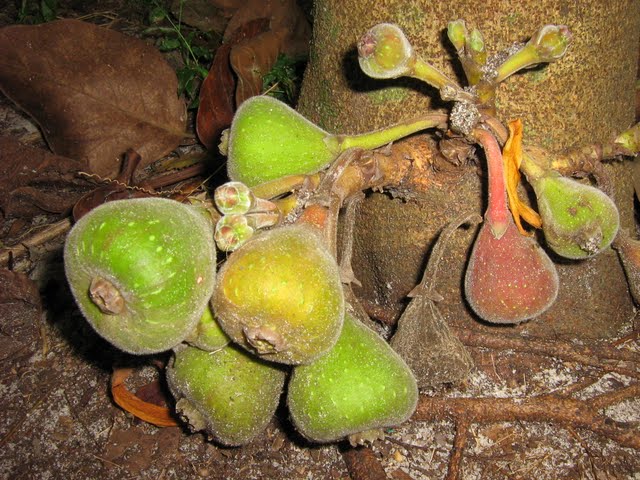
The photos given below were taken during my last trip to Olavipe. We call the tree athimaram and the fruit athipazham. I am told that in English it is known as Elephant Ear Fig tree or Giant Indian Fig and the botanical name is Ficus auriculata Lour. It grows wild, to about 10m or so height.


Click to enlarge
Copyright reserved.
Fig is an ancient fruit tree. Its cultivation is believed to have started two or three millenniums back. There are nearly 800 types of Ficus genus. This in the photo is one. They belong to the mulberry family. Fig is Brahma’s Holy Tree and is also mentioned in the Bible and the Koran. The banyan tree also belongs to this group and therefore is significant to the Buddhists as well. Adam and Eve, it is said, covered their nakedness with fig leaves when they were banished from Eden.
I think the most important fig is Ficus carica Linn [Moraceae]. Its nutritive index is 11 against 9 of apple. It is supposed to contain vitamins and minerals including vitamin A, vitamin B1, vitamin B2, iron, calcium, manganese, phosphorus, sodium, potassium chlorine, Omega 3, Omega 6, calcium, Pectin and so on.
Some of the problems where Ficus carica is said to be helpful include, sexual weakness, smooth labour, lowering cholesterol, preventing coronary heart disease, protect against cancer, effectively control of diabetes, management of hypertension, resisting vision loss in elderly people, and strengthening of bones.
The fruits are seasonal. But dried fruits are available in shops throughout the year. In fact, 80% of the production is consumed in dry form. In certain cases figs are used as replacement for sugar. They also have an important presence in the confectionery industry.
Fig is truly a wonderful fruit.
Sunday, May 29, 2011




Subscribe to:
Posts (Atom)